
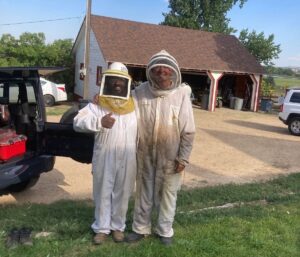
 CTRC has welcomed some very special new residents to the property—honey bees! Thanks to Alan Smith, the father of CTRC rider Alisun Smith, a hive now has a home right here at the center. Alan has been a dedicated beekeeper for more than 20 years and recently placed one of his hives on our land.
Alan tends to the bees during Alisun’s weekly riding classes, checking in on the colony to ensure they are healthy and thriving. This particular colony was caught in a swarm just a mile from Alan’s home—a natural process where a queen leaves her original hive with a group of worker bees to establish a new one. Today, the colony has grown to over 10,000 bees.
For now, the hive is focusing all its energy on getting established and building up enough resources to make it through the winter. While we won’t harvest honey this year, Alan anticipates that in future seasons the hive will produce enough surplus honey to share.
Beyond honey, the bees provide incredible benefits to the environment. Honey bees are vital pollinators, supporting the growth of flowers, fruits, and vegetables. Bees offer crucial benefits by pollinating about a third of the world’s food crops and wild plants, supporting biodiversity and ecosystem health. They are vital for producing fruits, vegetables, nuts, and seeds, and even help pollinate crops like clover and alfalfa for livestock feed. A single bee can travel up to five miles in search of nectar and pollen, though most foraging is done much closer to the hive for efficiency.
As winter approaches, the bees will form what’s called a winter cluster inside the hive, huddling tightly around the queen. By vibrating their wings, they generate heat to keep the colony warm, rotating positions so that no bee is left in the cold for too long. On warmer winter days, a few foragers will venture out to look for food, though the hive relies primarily on its stored honey to survive until spring.
Recently, CTRC caretaker Derrick suited up alongside Alan to learn the basics of hive care. “It was great,” Derrick shared. “I got to get in there and see the small details of the hive. Watching them work in unison was fascinating. Alan says that at this rate, they have made enough honey to be very happy over the winter.”
We’re excited to see how this new colony grows in the years ahead. Not only will they provide honey down the road, but their pollination work is already benefiting the plants and pastures that make CTRC a thriving environment for our herd and community.






Leave A Comment
You must be logged in to post a comment.